Published on: August 29, 2026
If you run a business for yourself, one question is bound to appear before you, or perhaps your tax advisor, at some point: Do I need GST registration? The short answer is: Not necessarily. A sole proprietorship and GST registration are two different things. A sole proprietorship is a type of business structure, whereas GST registration is a tax procedure that becomes mandatory when you cross a turnover threshold or have opted to register voluntarily under specific scenarios.
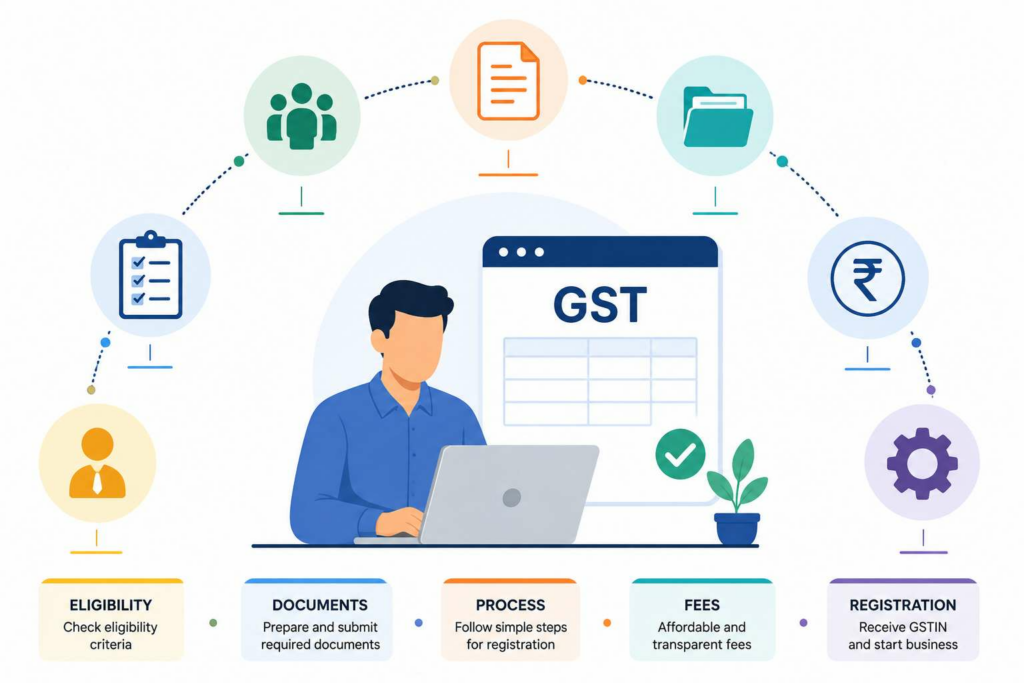
Your eligibility for GST registration largely depends on factors such as your turnover, the nature of your supplies (if any), your location and the state GST laws, among other factors.
What Is GST Registration for a Sole Proprietorship?
GST registration is a process wherein you apply and get registered under the Goods and Services Tax system, and assign a Goods and Services Tax Identification Number (GSTIN) to yourself.
For a sole proprietorship, there is no separate legal entity apart from the proprietor. Hence, there is no separate PAN for a sole proprietorship. The GST registration for a sole proprietorship is done in the proprietor’s name, and he or she needs to quote his or her PAN while applying for GST registration.
Thus, GST registration for a sole proprietorship does not create a separate entity; it simply brings the proprietor under the GST regime.
It is also important to note that sole proprietorship registration and GST registration are not the same thing. A person can be running a proprietorship business and not need GST registration right away, depending on his or her turnover and other factors.
Is GST Registration Mandatory for a Sole Proprietorship?
Not for everyone. A sole proprietor generally needs to get GST registration only when his or her turnover crosses the GST threshold limit. However, this turnover threshold is not a fixed limit. Some states have a higher turnover threshold for goods and services and some have a lower one.
For services, the turnover threshold for mandatory GST registration is usually INR 20 lakh (INR 10 lakh for service providers in special category states). For goods, there is an exemption up to INR 40 lakh (in some states) beyond which GST registration becomes mandatory. Certain states have a lower turnover threshold for goods.
Since it varies from state to state, it is unwise to assume that there is a universal GST turnover threshold of INR 20 lakh across the board.
Are There Other Scenarios When I Have to Register My Sole Proprietorship Under GST?
Yes. Apart from crossing the turnover threshold, GST registration under certain special scenarios also becomes mandatory. For instance, persons making inter-state taxable supplies, persons liable to pay tax under reverse charge, and certain persons supplying through specified e-commerce operators may have to get themselves registered under GST, subject to applicable exemptions and notifications.
Therefore, it is not mandatory to register under GST for all kinds of inter-state sales or for all kinds of e-commerce sales. It depends on whether the particular transaction falls under the notified category.
Can I Register Myself as a Sole Proprietor Voluntarily?
Yes. Any person who is not liable to register can choose to register voluntarily. Voluntary registration under GST can be beneficial in some cases.
For instance, suppose your clients want to deal only with GST registered suppliers. Or, say you want to claim input tax credit on the goods and services you purchase. In such a situation, voluntary registration can be a smart choice.
However, remember that voluntary GST registration comes with responsibilities as well. You cannot choose to register under GST just for the sake of having a GSTIN. It is imperative to assess your situation and determine whether voluntary registration is right for you.
What Is Aggregate Turnover?
The official CBIC definition says aggregate turnover includes taxable supplies, exempt supplies, exports and inter-State supplies of persons having the same PAN, calculated on an all-India basis. It excludes taxes such as CGST, SGST, UTGST, IGST and cess, and inward supplies on which tax is payable under reverse charge.
Aggregate turnover is calculated on an all-India basis for persons liable to pay tax under GST. This includes turnover from all taxable and exempt supplies, exports and inter-state supplies in respect of persons with the same PAN, less applicable exemptions as notified by the government.
This is an important point for sole proprietors who may be managing multiple businesses. If you are operating multiple businesses under the same PAN, you have to calculate aggregate turnover for the purpose of GST registration.
Documents Required for GST Registration for a Sole Proprietorship
The documents required for GST registration for a sole proprietorship depend on the nature of your business, especially your business premises.
Here is a list of documents that you need to prepare:
- PAN of the proprietor
- Aadhaar or other identity proof documents
- Recent photograph
- Valid mobile number and email ID
- Proof of your principal place of business
- Proof of your additional place of business (if any)
- Details of goods and services
- Bank account details (if applicable)
- Details of authorised signatory and verification
The GST portal has a specific list of documents that are acceptable proofs of your principal or additional place of business. For instance, electricity bills, property tax payment receipts, municipal khata copies, rent or lease agreements, consent letters and government documents are a few examples of acceptable proof of business premises.
What Can I Submit as Proof of My Business Premises?
This is one area where the generic GST document checklist can mislead you.
You cannot submit every document listed in the GST document checklist as proof of your business premises.
You must understand how you occupy your business premises in order to determine which documents you can submit as proof of your business premises. Here’s a brief explanation:
If you are the owner of the business premises:
You can submit a property tax receipt, khata copy, electricity bill or any other relevant proof of the property.
If you are a tenant:
You will have to submit a rent or lease agreement along with proof of the property.
If you are occupying the premises on behalf of another person with his or her permission:
You can submit a consent letter along with relevant proof of the premises.
The GST portal lists property tax receipts, khata copies, electricity bills, rent or lease agreements, consent letters and government papers among the documents that can be submitted as proof of your business premises. Therefore, while there is a wide range of documents that can be submitted as proof of business premises, it is important to know which category you fall in before you submit the documents.
How to Apply for GST Registration for a Sole Proprietorship Online
The application for GST registration needs to be made online by filling up Form GST REG-01 on the GST portal. For sole proprietorship registration online, the proprietor can complete the GST registration process digitally by providing the required business details and documents.
The process of GST registration for a sole proprietorship includes the following steps:
Step 1: Visit the GST Portal to Start Your Application
Visit the GST portal and select the option for a new registration. Choose the appropriate application type and proceed with the registration process.
Step 2: Fill Up Your Basic Information
Enter your basic information, including your state, legal name as per PAN, PAN, email address, and mobile number. Ensure that your contact details are accurate, as an OTP will be sent to your registered mobile number for verification.
Step 3: Generate a Temporary Reference Number (TRN)
After submitting your basic details and verifying your mobile number, the GST portal will generate a Temporary Reference Number (TRN). You can use this TRN to save your application and access it later to complete the registration process.
Step 4: Complete the GST REG-01 Application Form
Use the TRN to reopen your application and complete the remaining sections of Form GST REG-01. The form generally includes:
Basic business information
Proprietor details
Authorised signatory details
Principal place of business
Additional place of business, if applicable
Details of goods and services
State-specific information
Aadhaar authentication
Verification
These details are required to complete the GST registration process for a sole proprietorship.
Step 5: Upload the Required Documents
Upload the applicable documents and provide the complete address of the principal place of business. Ensure that all information matches the supporting documents, as incorrect or incomplete details may lead to queries or rejection of the application.
Step 6: Complete Aadhaar Authentication
Complete Aadhaar authentication through the available OTP or biometric verification process. Depending on the application and applicable requirements, biometric authentication may require a visit to a GST Suvidha Kendra.
Step 7: Submit the Application
Review the information entered in the application and submit it electronically through the applicable e-verification or signing method. Once successfully submitted, you will receive an Application Reference Number (ARN), which can be used to track your application.
Step 8: Track Your Application Status
Use the Track Application Status option on the GST portal to monitor your application using the ARN. If the GST authorities request clarification or additional documents, the response must be submitted digitally within the specified timeframe.
How Long Does It Take to Get GST Certified?
GST registration is generally processed within 3 working days if the application and documents are in order.
If objections or additional verification are required, the process may take up to 17 days.
The timeline depends on document accuracy, Aadhaar authentication, and verification requirements. Therefore, GST registration should not be assumed to be completed within 24 hours.
When Should I Apply for GST Registration as a Sole Proprietor?
If you are liable to get GST registration, make sure that you apply well in time.
According to the CBIC guidelines, an unregistered person has a period of 30 days from the date on which he or she becomes liable to get GST registration to complete the registration process.
As mentioned earlier, the effective date of GST registration can vary depending on the circumstances. Therefore, when you are approaching or have crossed the turnover threshold, it is necessary to evaluate your GST registration liability and comply with the deadlines.
What Are the Fees for GST Registration?
There are no government fees for GST registration on the GST portal. However, if you are making use of the services of a Chartered Accountant, tax advisor, legal expert or any other professional to file the application for GST registration, he or she may charge you a processing fee for the same.
Therefore, in order to understand your liability for GST registration fees, make sure that you distinguish between government fees and professional service charges.
What Are the Next Steps After Completing GST Registration?
Once you have received your GST certificate, you must complete a few steps in order to ensure that your GST compliance remains up to date. The steps can vary depending on the nature of your business, but here are the usual next steps after GST registration:
- Issuing invoices and collecting GST
- Settlement and payment of GST liabilities
- Filing of GST returns or statements
- Maintaining books or electronic records
- Reconciliation of tax liabilities
- Claiming input tax credit wherever applicable
- Responding to GST notices, if any
- Updating registration particulars, if applicable
Do I Have to File GST Returns Even If I Do Not Have Any Business?
Yes. Filing of GST returns is a continuous compliance requirement even if you are not operating your business. The taxpayer guidance document issued by GSTN specifically mentions that filing of returns can become mandatory even if the taxpayer has not engaged in any outward or inward supplies.
This is yet another reason why sole proprietorships should think twice before getting voluntarily registered under GST.
Difference Between GST Registration and Sole Proprietorship Registration
Sole Proprietorship vs GST Registration
1. Meaning
- Sole Proprietorship: A particular type of business ownership.
- GST Registration: A process that makes you liable to pay and collect GST.
2. Legal Entity
- Sole Proprietorship: There is no separate legal entity apart from the owner of the business.
- GST Registration: Does not create a separate legal entity.
3. PAN
- Sole Proprietorship: Does not have a PAN separate from the proprietor’s PAN.
- GST Registration: Uses the proprietor’s PAN for registration.
4. GSTIN
- Sole Proprietorship: Does not automatically provide a GSTIN.
- GST Registration: The proprietor is assigned a GSTIN after registration.
5. GST Liability
- Sole Proprietorship: A sole proprietor may not be liable for GST unless applicable conditions are met.
- GST Registration: Once registered, the proprietor is liable to pay and collect GST in accordance with GST rules and regulations.
6. Registration
- Sole Proprietorship: GST registration does not entail sole proprietorship registration.
- GST Registration: GST registration is separate from sole proprietorship registration.
7. Other Registrations
- Sole Proprietorship: Owners can have other mandatory or voluntary registrations depending on their business needs.
- GST Registration: GST is one of the registrations that may apply depending on the business and its requirements.
Benefits of GST Registration for a Sole Proprietor
While GST registration is primarily a compliance requirement, it can bring certain benefits to a sole proprietor, such as:
- Ability to collect GST on taxable supplies
- Eligibility to claim input tax credit on purchases
- Ease of doing B2B transactions as a registered supplier
- Enhanced credibility as a GST registered dealer
However, it is important to keep in mind that GST registration comes with compliance obligations. Therefore, you should only get GST registered if it makes business sense for you.
Common Errors to Avoid During GST Registration
- Using a different legal name: Ensure the name matches your PAN records.
- Uploading wrong premises documents: Submit valid proof of your business premises.
- Skipping Aadhaar authentication: Complete Aadhaar authentication within the specified timelines.
- Providing incorrect business details: Ensure the business activity matches the actual activity and supporting documents.
- Stopping after GST registration: Continue complying with GST rules and regulations after receiving your GST certificate.
Why Choose Vakilsearch for GST Registration?
Registration under GST can be a complicated and time-consuming exercise, requiring an understanding of the eligibility requirements and preparation of relevant documents, including Aadhaar authentication. Correctly identifying the requirements may help avoid unnecessary amendments or clarifications.
Expert help with your GST registration is just a click away and includes assistance with:
- Assessment of your GST registration eligibility
- Preparation and verification of the required documentation
- Guidance and assistance with the GST registration application
- Aadhaar authentication and verification
- Processing of your GST registration application
Whether you are registering voluntarily or your turnover has crossed the threshold limits, experienced professionals can assist you with the registration process and save you from GST-related compliance headaches.
Conclusion
GST registration of a proprietorship firm is not mandatory for all types of businesses, as eligibility is determined on a case-to-case basis. Factors such as turnover, supplies, location, and applicable GST thresholds should be taken into account while applying for registration.
Pre-application eligibility assessment, gathering the required documents, and verification can help ensure a smooth application process. Additionally, businesses should remember that filing returns and following other compliance requirements are also part of GST registration.