Published on: September 26, 2026
- A three-day summit, organised by the Government of Goa in association with Tricog Health, convened policymakers, clinicians, public health leaders, researchers and implementation experts from across India.
- State CVD experiences from Goa, Uttar Pradesh, Karnataka, Odisha, Maharashtra, Manipur, Mizoram, Meghalaya, Nagaland, Assam, Bihar, Jharkhand, Kerala, Tamil Nadu, Punjab and New Delhi informed discussions on what a scalable national heart-attack response could look like.
- Deliberations spanning prevention, screening, paediatric and women’s cardiovascular health, reperfusion, AI, heart failure, data and financing culminated in recommendations for the Ministry of Health and Family Welfare. These focused on scalable cardiovascular care across prevention, STEMI and reperfusion systems, paediatric and women’s heart health, heart failure, data infrastructure, and the responsible use of technology.
Goa, 26 September 2026: The National CVD Summit 2026 concluded in Goa after three days of focused deliberations aimed at narrowing the gap between cardiovascular policy and on-ground implementation. Organised by the Government of Goa in association with Tricog Health, the summit kicked off on 25 September 2026 at Varca, Goa, under the theme “Policy and Implementation for Scalable Cardiovascular Care.”
The summit brought together policymakers, cardiologists, physicians, endocrinologists, paediatric and maternal health specialists, public health leaders, researchers, programme implementers and health technology experts to examine the cardiovascular care continuum, from prevention and early detection to emergency response, referral, treatment and long-term management. Across scientific presentations, state case studies and panel discussions, the focus remained on models that can move beyond isolated centres of excellence and work reliably across districts, states and varied health-system settings.
Shri Vishwajit Rane, Hon’ble Minister for Health, Government of Goa, led the formal inaugural ceremony on 26 September and said, “Thirty-five years ago, when my father had a heart attack, there was no ambulance and no cardiac expertise nearby, only a drive to Goa Medical College and a phone call to doctors in Bombay and the United States for guidance. That is the gap this programme was built to close. In Goa, no patient is turned away, and no protocol is compromised, and patients get everything free of cost from Treatment to Medication.”
Shri Yatindra M. Maralkar, IAS, Health Secretary, Government of Goa, addressed the gathering, emphasising, “Every district hospital in Goa is now connected to a STEMI referral pathway, backed by Tricog’s AI-enabled ECG diagnostics at the point of care.”
Dr Charit Bhograj, Founder & CEO, Tricog Health, spoke on behalf of the host partner. He said, “Every heartbeat deserves the same thing my own family would get with one phone call: the right treatment, in time. Most of India doesn’t have that privilege yet. That’s the gap we built Tricog to close.”
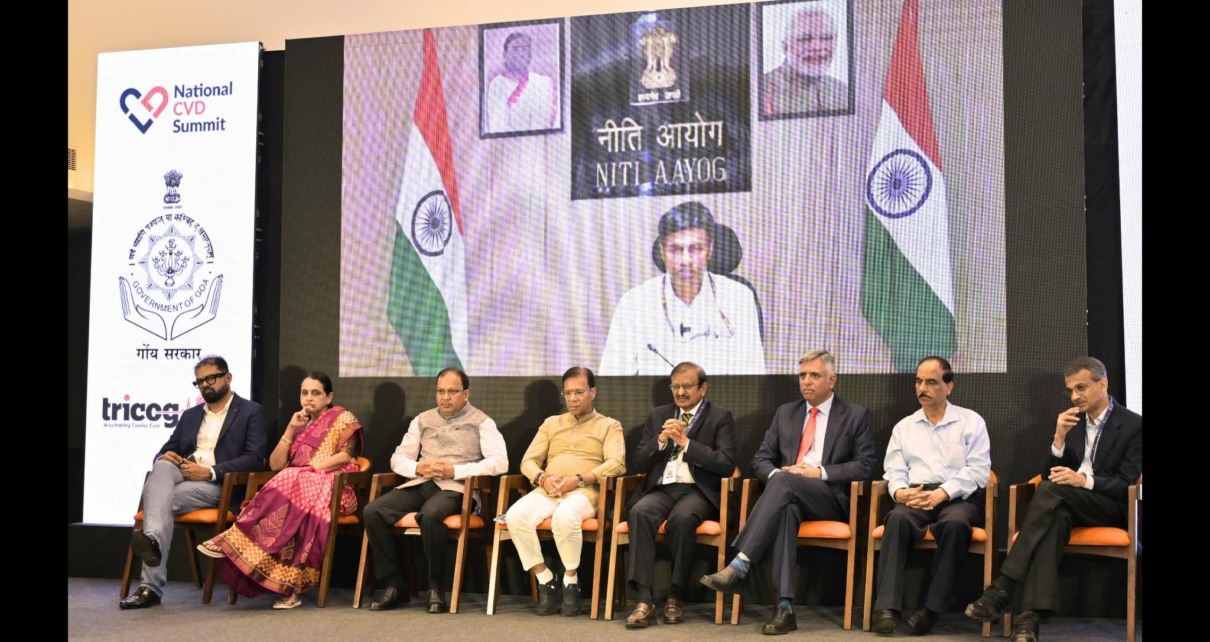
Dignitaries and healthcare leaders at the inaugural session of the National CVD Summit 2026 in Goa.
From risk factors to earlier detection
The first day established the breadth of India’s cardiovascular challenge. Sessions examined the burden of cardiovascular disease (CVD) and the way hypertension, diabetes, dyslipidaemia and cardio-kidney-metabolic risk feed into it. They also examined population-based screening within the NP-NCD framework. The programme then moved to paediatric cardiovascular disease, including congenital and rheumatic heart disease, and to cardiovascular disease in women, including gaps in recognition, prevention and care and the management of cardiac disease during pregnancy.
Wing Commander Dr Shamanna S. Iyengar, Chair, Scientific Committee, National CVD Summit 2026, and Consultant Cardiologist, Manipal Hospital, Bengaluru, said: “Cardiovascular disease remains the world’s leading cause of death: 19.4 million lives lost in 2023, 28.6% of all deaths globally, with male CVD rates up nearly 43% since 1990. That picture lands squarely on India, where nearly 3.1 million lives were lost to CVD in 2024 alone, against a backdrop where diabetes, abdominal obesity and high cholesterol are now the norm rather than the exception. Close to 80% of this burden is preventable, and today’s sessions carried that forward, turning attention to where India’s data has been thinnest: rheumatic and congenital heart disease in children, and the long-standing gap in recognising and treating heart disease in women.”
A recurring theme was that India’s response cannot begin only after a major cardiac event. Participants discussed how screening, earlier risk identification, clearer referral pathways and stronger continuity between community programmes and specialist care could help reduce avoidable delays. Panel formats were designed to turn discussion into practical, chair-distilled suggestions for the Ministry of Health and Family Welfare to consider.
Dr C. N. Manjunath, Member of Parliament and former Director of the Sri Jayadeva Institute of Cardiovascular Sciences & Research, delivered the keynote address on “Cardiovascular Care in India,” and said, “Sixty per cent of India lives without access to a cath lab, and every thirty minutes of delay raises the risk of death by seven per cent. We already have what we need: tenecteplase, AI-assisted diagnosis, and a hub-and-spoke model proven in both Karnataka and Goa. What’s missing is the policy to match it, at scale, everywhere. Heart attack cannot wait.”
Learning from state STEMI systems
A major focus of the summit was India’s response to ST-elevation myocardial infarction, where time to diagnosis and reperfusion can determine outcomes. The programme brought together implementation experiences from Goa, Uttar Pradesh, Karnataka, Odisha, Maharashtra, Tamil Nadu and Punjab, allowing delegates to compare how different states are approaching hub-and-spoke networks, first-contact diagnosis, transport, spoke capability, referral and data systems.
Goa’s own hub-and-spoke STEMI experience was discussed alongside other state models, giving the summit a practical implementation lens rather than a purely academic one. Dr Guruprasad Naik, HOD of Cardiology, Government Medical College, Goa, said: “The state of Goa has led the design and implementation of a statewide STEMI program, starting in 2018. Building on this, we are excited that the state of Goa is hosting the National CVD Summit. We are hoping that this will further stimulate an understanding of the impact of the various forms of CVD on the Indian population, leading to improvements in care and outcomes for the entire Indian population.”
A separate session on reperfusion strategies examined fibrinolysis, primary PCI and pharmaco-invasive approaches, including the operational reality that the ideal treatment strategy must also account for geography, access, time, infrastructure and affordability.
Technology, evidence and heart failure
The summit also examined what it takes to scale cardiovascular programmes from pilots to population scale. Special sessions focused on closing data gaps, building integrated repositories for research and decision-making, and using evidence, health technology assessment, and financing frameworks to support public health adoption.
A dedicated session on AI and technology explored the role of national-scale clinical operations, AI-enabled diagnostics and the regulatory considerations involved in deploying medical devices within CVD programmes. This was followed by state reflections on implementation, giving participating states an opportunity to share what had worked, what remained difficult and what could be adapted elsewhere.
Heart failure, often diagnosed late and managed across fragmented care pathways, formed the final major scientific track. Discussions covered registry evidence, earlier identification of left ventricular systolic dysfunction, statewide pathways, gender-related differences in outcomes, and the case for stronger surveillance. The emphasis was on connecting detection to decentralised management, specialist referral and longitudinal care rather than treating diagnosis as the endpoint.
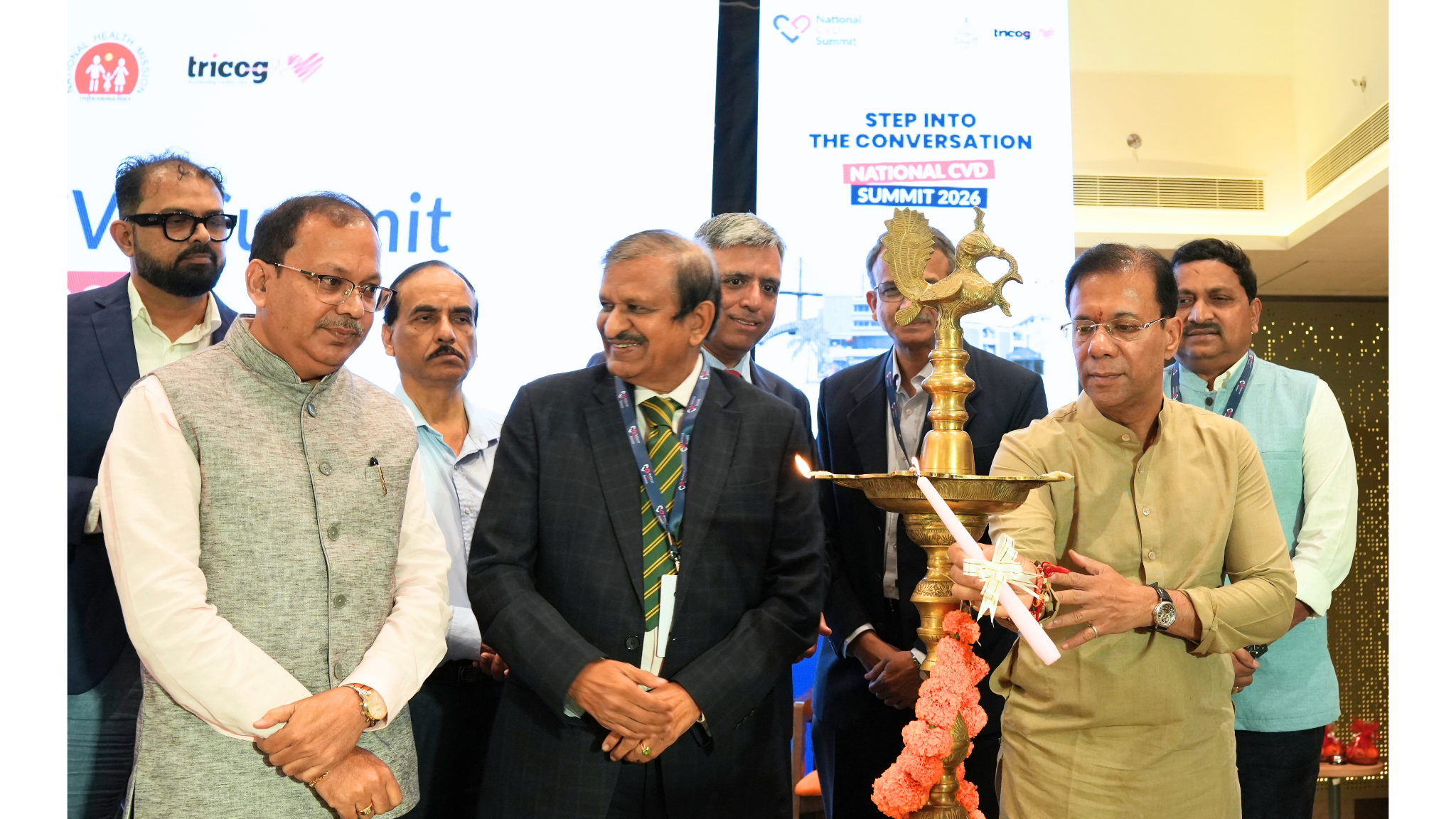
Ceremonial lamp-lighting marks the inauguration of the National CVD Summit 2026 in Goa, in the presence of dignitaries and healthcare leaders.
From deliberation to recommendations
A closed-door document-preparation session forms part of the Summit programme, designed to consolidate the principal learnings and chair-led suggestions generated across the discussions into a structured set of recommendations for the Ministry of Health and Family Welfare. The exercise focuses on scalable cardiovascular care, with particular attention to prevention and screening, STEMI systems, reperfusion access, paediatric and women’s cardiovascular health, heart failure, data infrastructure and the responsible use of technology. Across its three-day framework, the Summit underscores a central implementation challenge: India already has strong clinical expertise, promising state programmes and increasingly capable digital tools, but achieving national-scale impact depends on connecting them through common pathways, dependable referral systems, measurable programme design, and sustained collaboration among government, clinicians, public health institutions and technology partners.
Coming just days ahead of World Heart Day on 29 September, the National CVD Summit 2026 placed renewed focus on prevention, early detection and timely treatment, and on building cardiovascular care pathways that can work at scale across India.
About the National CVD Summit 2026
The National CVD Summit 2026 was organised by the Government of Goa in association with Tricog Health India. The summit convened policymakers, clinicians, public health leaders, researchers, and implementation experts around the theme “Aligning Policy and Implementation for Scalable Cardiovascular Care.” Its sessions covered cardiometabolic disease, population-based screening, paediatric cardiovascular care, cardiovascular health in women, STEMI response and reperfusion, heart failure, AI and digital health, and national CVD care pathways.
About Tricog Health
Founded in 2014 by interventional cardiologist Dr Charit Bhograj, Tricog Health is an AI-powered cardiac care company that combines connected medical technology, artificial intelligence, cloud infrastructure, and clinical expertise to enable faster detection and management of cardiovascular disease. Tricog’s platforms have screened 40M+ patients, identified 500K+ heart attacks and flagged nearly 1.5M critical ECG findings. Its technology supports 12K+ customers across 15K+ installations spanning hospitals, clinics, diagnostic centres, and public health programmes, including large-scale collaborations with various state governments.
Tricog Health: https://tricog.com/ | Accelerating Cardiac Care
Media Contact
Shubham Mandal, Deputy Manager | [email protected]
Haritha Nair, Senior Associate | [email protected]