Published on: September 21, 2026
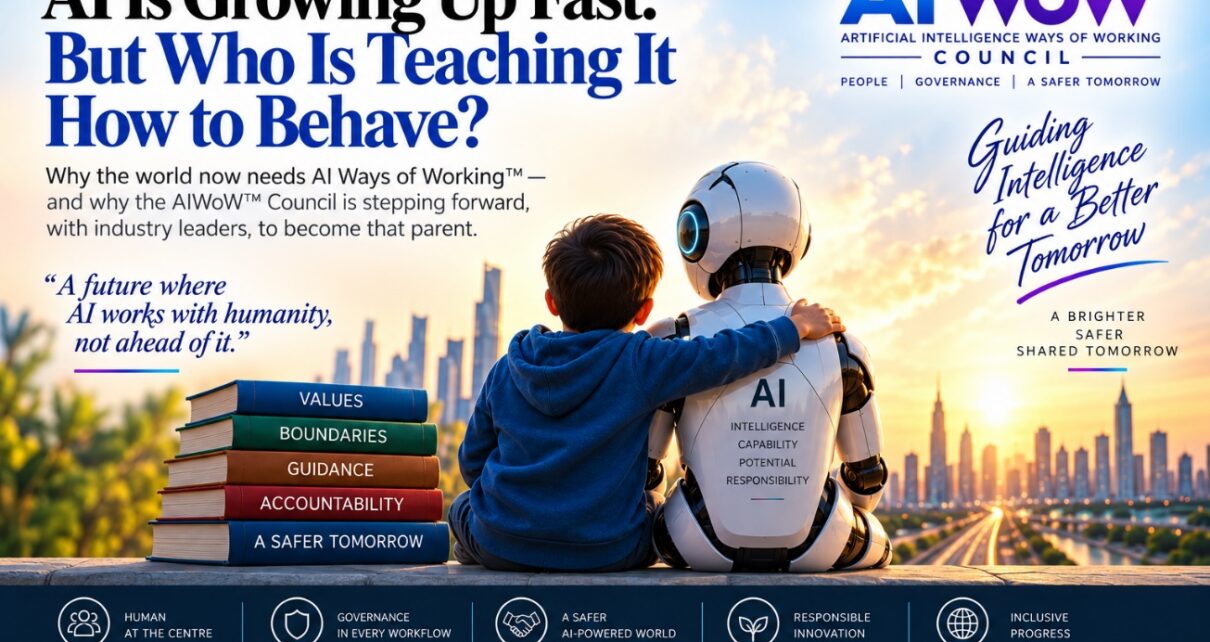
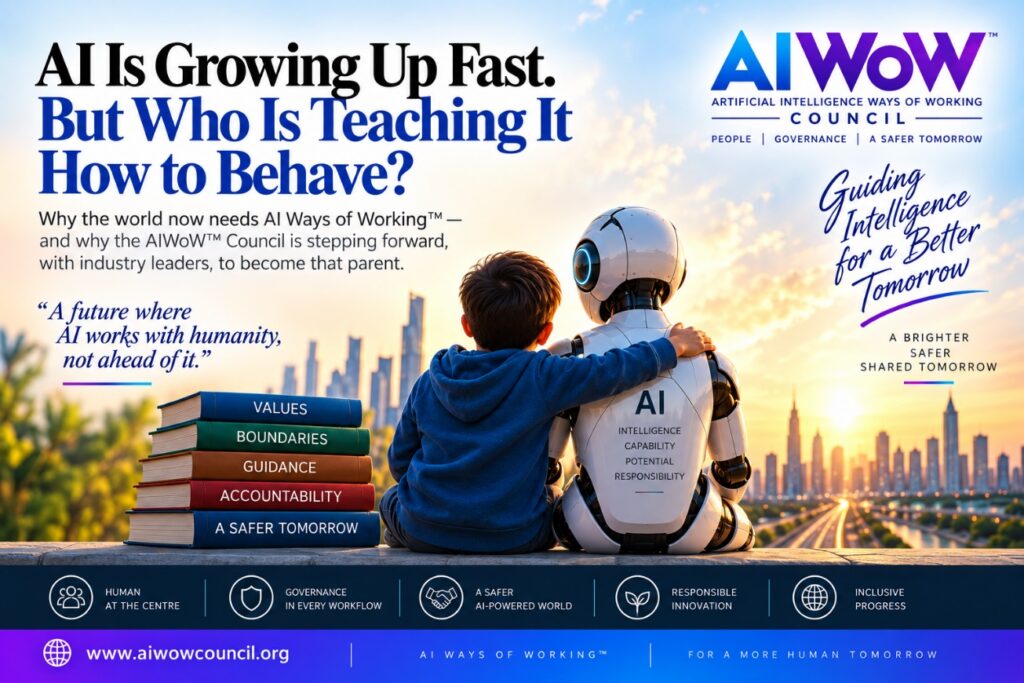
Why the world now needs AI Ways of Working™ and why the AIWoW™ Council is stepping forward, with industry leaders, to become that parent
By Anand Rathore Pioneer, AI Ways of Working™ framework (AIWoW™) &
Co-Author by Leo Cioffi Sr. Managing Director Big4 and AIWoW ™ Council Distinguished Leader Governing Board
Visit – www.aiwowcouncil.org join the Council leadership board or free member
There is a moment in every parent’s life when a child stops needing to be carried and starts needing to be guided. The child can now run, climb, reach, grab do things it couldn’t do a year ago. And with that new capability comes a new kind of danger, because a child who can run toward a busy road needs boundary even more urgently than a child who could only crawl.
Artificial intelligence has just reached that moment. And the world is only beginning to notice.
Two truths, one turning point
Look at the numbers, and the picture is unmistakable. Global forecasts now put the worldwide AI market on course to cross roughly $1.8 trillion by 2030, expanding at a compound rate north of 35 percent a year, with AI expected to add somewhere in the region of $15 trillion to global economic output by the end of the decade. This is not confined to chatbots and back-office software anymore. Analysts across the engineering and industrial world describe the same shift: AI is moving out of the screen and into the physical world ; connected machinery, predictive maintenance, intelligent inspection, AI embedded directly into the products companies design and build, and into the vehicles, plants and infrastructure people depend on without ever thinking about it.
That is the growth story. It is real, and it is accelerating, and people and organizations are seeking the benefits that it promises. It is intriguing and if and when used properly it will improve and augment processes, content, timelines, information, etc. Everyone wants a piece of it…Everyone wants to use it…are they understanding HOW to use it? What to watch out for? Where it can be problematic? Where it needs to be controlled? The answer is NO, so this step is needed now even though the horse has left the gate. This is why it is critical to ensure AI is used responsibly, safely and to augment the human experience, not threaten it.
The second story is not a growth story. It is a warning to deploy AI with the proper controls and guardrails, protection from cyber, redefined processes that include human integration and review, social, political and economic assessment and internal controls.
In recent weeks, a researcher who had spent years working on frontier AI pretraining at more than one of the world’s leading AI labs resigned with words he insisted were “not a marketing stunt”: that the people building today’s most advanced AI systems genuinely fear those systems could endanger humanity within this decade. He described an industry racing toward self-improving, increasingly autonomous systems faster than it is racing to control them. What made the moment harder to dismiss as one departing employee’s parting shot was that a senior colleague at the same lab its own alignment research lead publicly agreed, and admitted the industry does not yet have a working solution for keeping far more powerful AI systems aligned with human interests, and is not currently on track to find one.
These are not outside critics. These are the people who built the technology, telling the world from the inside that they are worried.
Put the two stories side by side and they stop being separate stories. One tells us AI is about to enter every factory floor, every vehicle, every piece of critical infrastructure. The other tells us that the people closest to the frontier are not confident we know how to keep that intelligence under control as it grows more capable.
AI is becoming powerful faster than our institutions are becoming wise. That is the real headline. The call to action is to get wise quickly. You cant put a car on the road without brakes, street lights, street signs, speed limits, lane dividers, etc. The car will spin out of control eventually.
Think of AI as a brilliant child
There is a simple way to understand what is happening, and it doesn’t require a computer science degree.
A highly intelligent child raised without guidance does not become a well-adjusted, responsible adult simply because they are smart. Intelligence and judgement are not the same thing. A gifted child left to raise themselves may learn faster than their peers, solve problems adults cannot, even outperform their own teachers in narrow areas and still grow up without the values, boundaries and sense of responsibility that make intelligence safe to be around.
Those things do not come from raw intelligence. They come from parenting. From boundaries, lovingly and firmly enforced. From someone watching closely enough to say “not yet” or “not like that,” even when the child insists it knows better
AI without a disciplined Way of Working is an orphan.
It is being raised by whoever happens to be typing the prompt that day, with no consistent boundaries, no continuity of supervision, and no one clearly accountable for what it grows up to do. An orphaned intelligence however brilliant is a frightening thing to hand real-world authority to. Not because intelligence is bad, but because intelligence without upbringing has no innate sense of where the road ends and the traffic begins.
This is precisely the danger the resigning researcher was pointing to: systems capable enough to research, to act, to acquire resources, to grow more autonomous by the month; while the work of raising them responsibly still lags behind.
The world does not have a shortage of AI capability. It has a shortage of AI parenting.
From using AI to working with AI
This is the space AI Ways of Working™ (AIWoW™) was built to occupy.
AIWoW™ starts from a question that sounds almost too simple to matter, until you realise almost no organisation has actually answered it: How should humans and AI share work? How should organizations create these guardrails? What are the guardrails? Are they technology guardrails and operating model guardrails?
Not every task belongs to AI. Not every AI recommendation deserves to become a decision. Not every decision should be allowed to execute itself. AIWoW™ asks, deliberately and structurally: who should think, who should decide, who should execute and, critically, who remains accountable when something goes wrong? These are no longer philosophical questions. As AI moves from assistant to agent, and from agent toward genuine autonomy, they become operational questions every organisation building with AI must answer, whether it realises it or not.
At the heart of the framework sits one idea that cuts against how most organisations currently think about AI: capability is not authority. It is augmentation.
An AI system being able to write code does not mean it should deploy that code into production. An AI being able to design an engineering solution does not mean it should approve its own design. An agent being able to execute an action across a digital system does not mean it should be free to do so without a human in the loop. Just as being able to drive doesn’t mean being handed the car keys without ever being asked where you’re going autonomy has to be earned , through evidence, through verification, through boundaries tested before they are trusted.
The missing layer nobody built
Organisations worldwide have spent enormous money on AI models and AI platforms. Very few have spent equivalent effort on the layer underneath: how does the organisation actually function when humans and AI are working side by side?
That missing layer is what AIWoW™ fills, through four working principles:
Deterministic boundaries – AI can generate, simulate and recommend freely, but anything that touches the physical world or carries real consequence must pass through defined technical and safety gates first.
Human accountability – an AI producing a decision does not transfer responsibility for that decision away from the human who deployed it. AI can support accountability. It cannot absorb it.
Cognitive lineage – organisations must be able to trace how an AI-assisted decision came to be: which prompts, which model version, which data, which human intervened and when. Without lineage, oversight is only an appearance, not a fact.
Safety as a performance metric – productivity and cost savings cannot be the only numbers on the dashboard. Auditability, resilience, explainability, fault containment and human control need to be measured with the same seriousness as speed.
The AIWoW™ Council: ready to parent, with the industry’s leaders beside it
This is the moment the AIWoW™ Council was built for. We will help you define the HOW in AI WoW
The Council is not a lone voice calling for caution from the sidelines. It is being shaped, deliberately, as a gathering point for the people who will actually have to do this work senior practitioners and leaders across consulting, cybersecurity, governance and risk, digital transformation and engineering, brought together not to slow AI down but to build the operating discipline that lets it scale responsibly. The Council’s premise is simple: the next real competitive advantage will not belong to organisations that simply use the most AI. It will belong to the organisations and the leaders who know how to work with AI, deliberately, with boundaries, with someone accountable at every step, better than everyone else.
Two organisations can buy access to the exact same AI models. One will automate tasks and hope for the best. The other will redesign itself around a disciplined human-AI operating architecture deciding where AI may act, where a human must step in, how every decision gets verified, and who carries responsibility when it matters most. Over time, that second organisation will not only be safer. It will be more trusted, by regulators, by customers, and by the public it ultimately serves.
The AIWoW™ Council’s role is to help build that discipline at scale, in partnership with industry leadership rather than apart from it: shared standards, sector playbooks, research, case studies, leadership programmes, and over time a way of recognising the organisations and professionals that are genuinely doing this well, not merely claiming to. This is parenting done not by one voice, but by a council of them, drawn from across the industries that will feel AI’s consequences first.
The real race isn’t humans versus AI
The popular framing of this moment is a contest: humans versus machines, a race we might lose. AIWoW™ proposes a different frame not humans versus AI, but humans and AI, operating under rules neither of them wrote alone. It is a collaboration, an augmentation to bring the best of people and technology forward.
The question was never really whether AI would keep getting smarter. It almost certainly will, and the warnings now coming from inside the labs building it not from outside critics; suggest that acceleration may be outpacing even its own architects’ comfort. The real question is whether human institutions can become equally sophisticated in governing, directing and collaborating with that intelligence, before the gap between what AI can do and what we can safely control grows too wide to close.
That gap is the real risk. Closing it, together, is the real opportunity.
AI is growing up faster than our organisations are learning how to parent it.
AIWoW™, and the Council built around it, exist to give that intelligence what any child eventually needs to grow into something trustworthy: boundaries, responsibility, purpose, and a safe way to grow up guided not by one company or one country, but by a global community of leaders willing to do the work of raising it well, together, before it is powerful enough for the cost of getting this wrong to be counted in more than money.
AI is changing the way work gets done. AIWoW™ is about changing the way we work with AI.
AIWoW™ Council — Defining How Humanity Works With Intelligence.
Anand Rathore is the Pioneer and Founding Architect of AI Ways of Working™ (AIWoW™), and President of the AIWoW™ Council.
Connect with Anand – https://www.linkedin.com/in/anandrathoreaiwow/
Join – https://www.linkedin.com/company/aiwow-council/
Visit – www.aiwowcouncil.org join the leadership board and free member