Published on: September 5, 2026
India’s two biggest online sales are about to collide again. Flipkart’s Big Billion Days 2026 is expected to begin around September 22–23, and Amazon’s Great Indian Festival will open its doors the same week, as it does every year. For roughly seven days, the two platforms will throw everything at shoppers — flash deals, bank discounts, exchange bonuses, and discount badges promising up to 80% off.
It is the best week of the year to buy a phone, a TV, or a washing machine. It is also the easiest week of the year to overpay while feeling like you got a bargain.
The difference between the two outcomes usually comes down to one question that no product page will answer for you: what did this product cost last month?
The trick hiding behind the discount badge
Here is a pattern that repeats every festive season. A pair of earbuds sells at ₹2,499 through June, July, and most of August. A few weeks before the sale, the listed price quietly climbs to ₹3,999. When the sale goes live, the earbuds appear with a bold “38% off” tag at ₹2,479.
The discount is technically real. The saving is twenty rupees.
This inflated-price theatre is most common in the ₹2,000–₹15,000 range — earbuds, smartwatches, mixers, monitors, small appliances — precisely the products people buy on impulse during a sale. Nobody remembers what a mixer grinder cost in July. The platforms know this.
Meanwhile, genuinely excellent deals do exist in the same sale, often on the same page. Flagship phones from last year, TVs, and laptops routinely hit their lowest prices of the entire year during this one week. The problem was never that sale discounts are fake. The problem is that real and fake discounts look identical on the screen.
The only thing that separates them is price history — and that is exactly the information the product page is designed not to show you.
Put the price history on the product page itself
There are ways to check what a product used to cost. You can search for it on a price tracking website, paste links, compare charts. But during a fast-moving sale, when you are hopping between thirty product pages in an evening, nobody actually does that for every item. The friction is too high, and friction is where discipline dies.
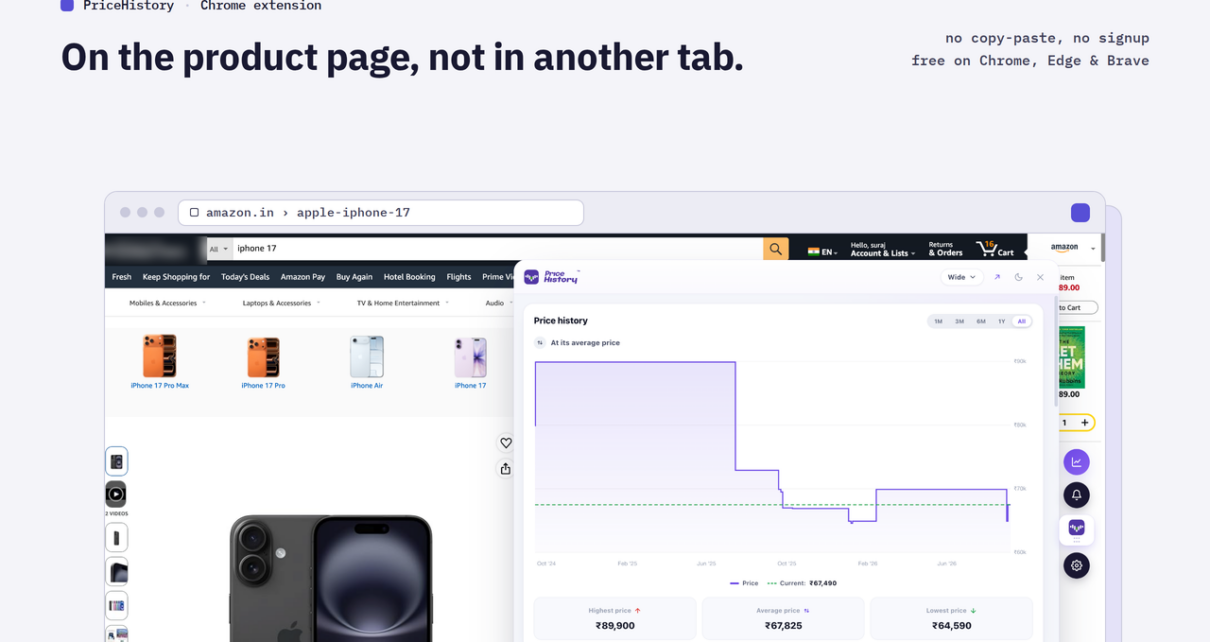
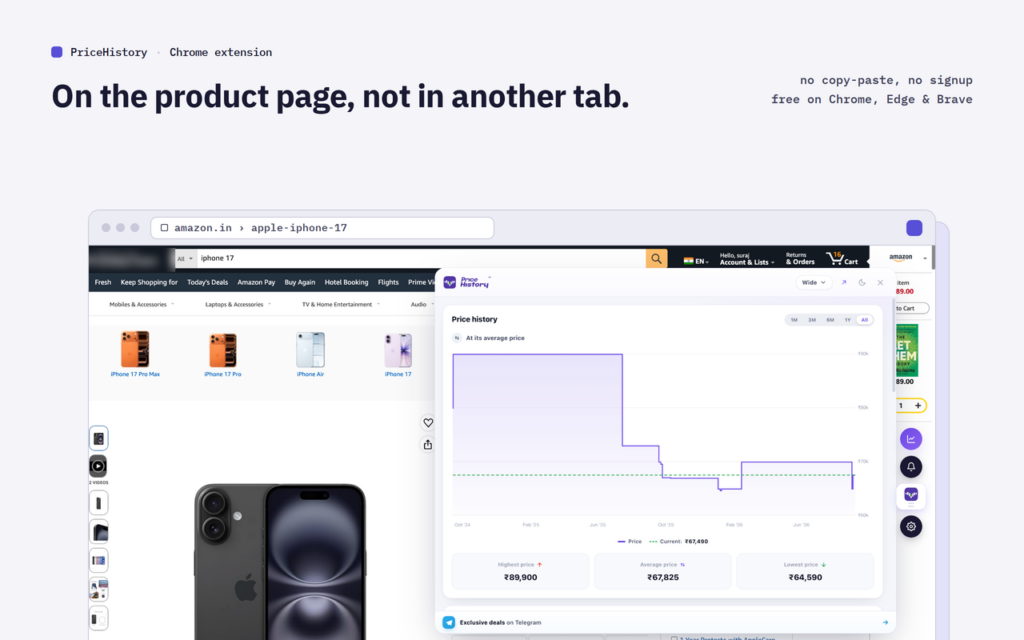
This is why, if you shop on a laptop or desktop, the single most useful thing you can do before the sale starts is install a price history checker Chrome extension for Amazon and Flipkart. The PriceHistory extension puts the answer where the question arises: directly on the product page. Open any product on Amazon or Flipkart, and the price chart appears right there alongside the listing — the lowest price the product has ever hit, its usual selling price, and how today’s “deal” compares.
No copying links. No switching tabs. No remembering to check. The evidence is simply present, every time, next to every discount badge.
The effect on your shopping is immediate and a little addictive. That “70% off” banner stops producing excitement and starts producing a glance at the chart. If the current price sits near the all-time low, you buy with total confidence — those moments genuinely happen during Big Billion Days and the Great Indian Festival, and now you can recognise them instantly. If the chart shows the product was cheaper in July than it is “on sale” today, you close the tab without a second thought. The oldest trick in e-commerce simply stops working on you.
Where it matters most this sale season
Because both mega sales run simultaneously, the extension quietly solves a second problem: cross-platform comparison. Amazon and Flipkart fight hardest over the same headline products, and identical items regularly differ by hundreds or even thousands of rupees between the two. With the price chart visible on both platforms as you browse, comparing is no longer a research project — it is just looking.
A few practical suggestions for the coming weeks. Install the extension now, before the sales begin, and browse your wishlist items once. You will immediately see each product’s all-time low, which becomes your personal benchmark — a far more honest number than any discount percentage. When the sales go live, judge every deal against that benchmark and nothing else. Phones, TVs, and large appliances deserve your attention during this window; fashion and budget items hit the same prices almost every month and deserve none of your FOMO.
The extension is free, works on Chrome and Chromium-based browsers like Edge and Brave, and requires no signup.
Big Billion Days and the Great Indian Festival will both deliver real bargains this year — they always do. The shoppers who capture them are not the fastest or the luckiest. They are simply the ones who can see the price tag’s past. This year, that can be you, one browser extension away.